From Mountain Farms to Your Plate: The Story Behind Nepal’s High-Altitude Pulses
The mountains from where a package of pulses originated are gone by the time it gets to our kitchen.
We notice a bowl of dal, beans, or lentils prepared for dinner. The farm where the crop was grown , the farmer who gathered it, the road it travelled, or the numerous hand engaged in transporting it from a remote agricultural region to a typical kitchen are things that we do not always witness.
That invisible journey has a significant role in Nepal's high-altitude pulses' final result.
For generations, farming communities in Nepal's mountainous areas have grown regionally adapted lentils and beans. For instance, traditional mixed beans, which comprise black, red, yellow, and spotted kinds, are produced at an elevation of about 2,300 meters in the Sinja Valley of Jumla. They have strong ties to regional cuisine, like Kwati. Traditional Himali black lentils are grown in Rasuwa by mountain agricultural groups.
These dishes have a location, a past, and a voyage.
And precisely because of that, they are worthwhile to comprehend.
The Story Begins with the Mountain
Farming in expansive, easily accessible productive areas is not the same as mountain agriculture.
Fields might be dispersed and smaller. Farms may be distant from roads and collection locations. Transportation might be challenging, and there is frequently limited access to processing, storage, and larger markets.
Many of these issues, such as dispersed farms, challenging terrain, poor post-harvest management, limited storage and processing, inadequate market access, and reliance on middlemen, were brought to light in a recent ICIMOD evaluation of agricultural value chains in Jumla and Bajura.
However, agricultural goods with strong local identities can also be found in these same areas.
An excellent example is Jumla mixed beans. They are connected to a certain region, agricultural community, and culinary custom; they are more than just beans picked somewhere in Nepal. According to FAO, they are an indigenous mountain dish that is strongly associated with Sinja Valley celebrations and culture.
Customers' need to learn more about the food they carry home is making that sense of origin more and more crucial.
What Makes High-Altitude Pulses Worth Discovering?
It is not appropriate to reduce the significance of high-altitude pulses to the notion that "higher altitude automatically means healthier."
Food is more intricate than that.
A pulse's variety, growth conditions, farming methods, and handling and processing after harvest all affect its characteristics. What makes mountain-grown pulses particularly interesting is the combination of local varieties, agricultural heritage and geographical identity behind them.
Some have remained part of local diets for generations.
Some are closely linked with traditional recipes.
Additionally, some are grown by communities where these crops continue to play a significant role in agricultural life.
For instance, in Rasuwa, Himali black lentils are part of the Tamang and Gurung mountain population’s culinary traditions and typically connected to meals like dal-bhat and bara.
As a result, people are discovering more than just another kind of pulse when these become more widely available. They are learning about a cuisine associated item with a certain region of Nepal.
But Growing the Crop Is Only Half the Journey
Even with a superb crop, a farmer may find it difficult to make money from it.
One of the realities of mountain farming is this.
Consider a farmer in a far- off village gathering beans. The closest significant consumer market could be hundreds of kilometers away, even though the crop is ready.
There are still few things that need to happen before those beans end up on a store shelf.
They need to be gathered.
They must be moved.
They need to be sorted and cleaned.
During storage, quality must be preserved.
The item must be packaged.
After that, it must get to merchants, distributors, and finally customers.
This complete journey is the agricultural value chain.
A simple way to look at it is:
Mountain Farm → Collection → Sorting & Quality Handling → Packaging → Distribution → Retail → Your Kitchen
When one part of this chain is weak, the impact can travel backwards all the way to the farmer.
Why Value Chain Management Matters
That bridge is the value chain. Moving produce from one place to another is only one aspect of effective value chain management.
It is about ensuring that each step functions as a whole.
This may mean that farmers have a more direct line of communication with consumers and marketplaces.
For companies, this involves creating more dependable sourcing and upholding product quality.
For customers, it means having easier access to goods that were previously only available in their home country.
And for local agricultural products, it creates another important opportunity: their identity does not have to disappear when they enter the commercial market.
Origin may contribute to the product's worth.
Nepal already has a good example of this.
In the past, Jumla mixed beans had trouble getting into bigger markets. The beans eventually made it to national grocery channels because to greater product identification, better collaboration between growers and market partners, and more transparent communication about their mountain origin. According to FAO, during the course of three years, production quadrupled and producers were able to get prices that were more than 25 percent higher.
The lesson is significant.
Sometimes the problem is not whether there is a worthwhile local product.
The challenge is whether there is a strong enough bridge between the person growing it and the person willing to buy it.
From Commodity to a Product with a Story
Many pulses start to appear interchangeable when they are marketed without information about their origins.
A bean turns into just a bean.
A lentil turns into just another dal package.
However, origin alters the discourse.
When a consumer learns that a pulse originated in a mountain farming community, is part of a traditional local variation, or is associated with a specific food culture, they are motivated to perceive the product in a new way.
This is why activities such as responsible sourcing, sorting, quality handling, packaging, traceability and storytelling matter.
In instance, packaging involves more than just making a product look good.
This is one of the last chances to tell the farm's tale.
According to FAO's Mountain Partnership experience in Nepal, sharing the history and provenance of Jumla mixed beans helped consumers recognize the authentic mountain product and facilitated its introduction into larger retail markets.
Keeping that identity visible adds value for both ends of the supply chain for goods that are transported vast distances from far-flung farms.
Where Mato High – Altitude Pluses Fit In
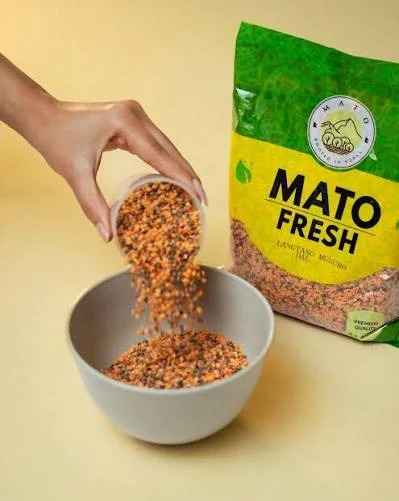
MATO’s high-altitude pulses category is built around this connection between origin and access.
For us, the possibilities goes beyond just putting a pulse from a mountainous area within a package.
The greater possibility is to facilitate the transportation of unique Nepali agricultural products from their producing sites to a larger consumer market.
This entails focusing on the entire process, including sourcing, collecting, quality control, packaging, distribution, and sale.
The product's story starts considerably earlier, even though a client could initially see it on a MATO shelf.
It starts on the farm.
MATO can assist customers in realizing that Nepal's food diversity goes much beyond what is often found in urban markets by maintaining that origin's visibility.
Better Market Access Creates More Possibilities
For mountain farmers, access to a dependable market can influence what continues to be grown.
Traditional products may have history and cultural importance, but farming is also a livelihood.
If farmers repeatedly struggle to sell a crop, the incentive to continue producing it becomes weaker. FAO has noted that traditional mountain products such as Jumla mixed beans and Himali black lentils face pressure from more productive or commercially attractive crops.
This is why value – chain development matters beyond logistics.
When collection improves, when quality is maintained, when product is properly presented and when customers are connected with the story behind them, traditional foods have a better opportunity to remain commercially relevant.
A strong market gives farmers another reason to keep producing.
And continued production helps keep local agricultural knowledge and food tradition alive.
Choosing Food with a Known Origin
Today, many consumers want to know more about what they eat.
Where was it grown?
Who produced it?
How did it reach the market?
What makes it different from another product sitting beside it?
These are valuable questions because they bring agriculture closer to the consumer.
High-altitude pulses give us an opportunity to have that conversation.
Instead of looking at pulses only through price or packaging, we can also look at origin, farming communities, local varieties and the value chain behind the product.
And that changes a simple grocery purchase into something more meaningful.
From Mountain Farms to Everyday Kitchen
The distance between Nepal’s mountain farms and our kitchens can be long.
But it does not have to feel disconnected.
A well-managed value chain can bring those two worlds closer together, helping farmers reach markets while helping consumers discover foods that carry a genuine sense of place.
That is the larger story behind MATO High-Altitude Pulses.
It is the story of food moving from remote farms through collection, careful handling, packaging and distribution until, finally, it reaches the table.
And when we understand that journey, even something as familiar as a bowl of dal begins to tell a much bigger story.
From mountain farms to your plate, MATO brings Nepal’s high-altitude pulses and the stories behind them is closer to everyday kitchens.
Related Blog